Secret Despatches from Arabia ... Published by Permission of the Foreign Office. Foreword by A.W. Lawrence
Book Description
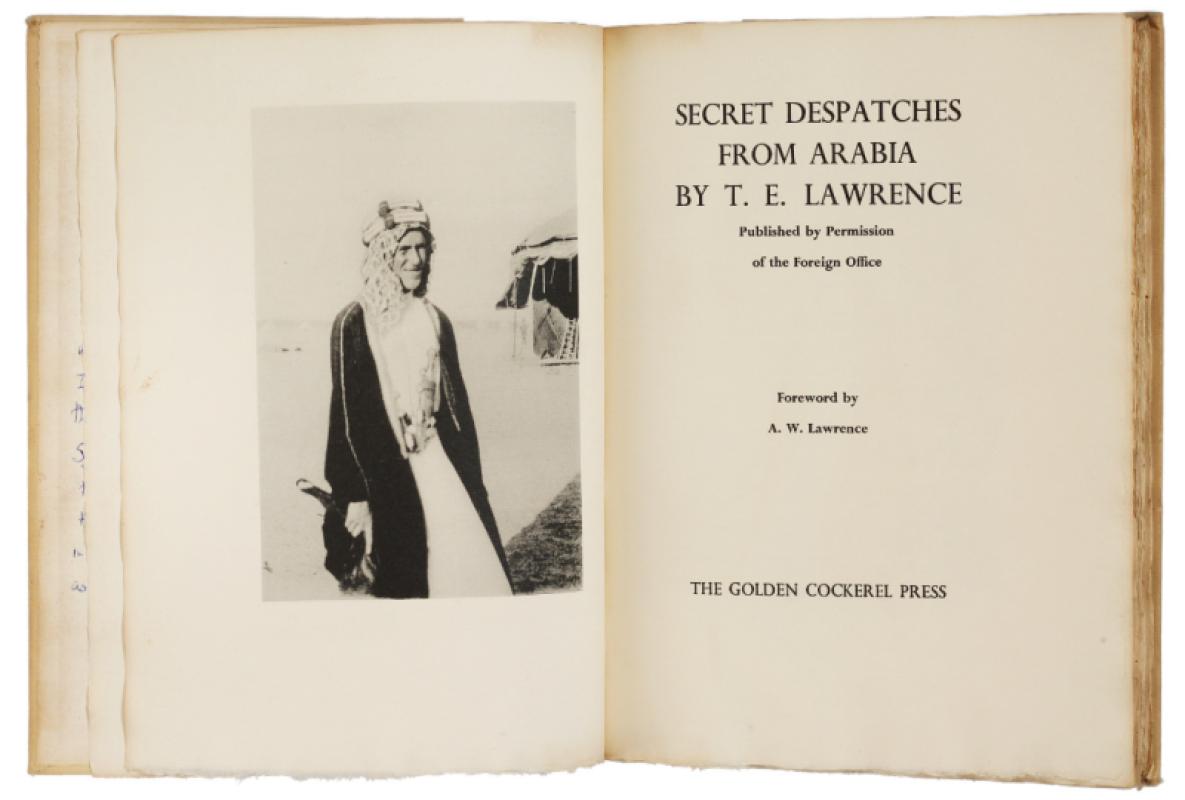
Quarto in 8s (251 x 190mm), pp. 173, [1 (blank)], [2 (colophon, blank)]. Collotype portrait frontispiece after B.E. Leeson. (Occasional light spots, a few marginal ash- or scorch-marks.) Original black niger morocco-backed canvas boards by Sangorski & Sutcliffe signed with their pallet on the upper pastedown, spine divided into compartments by raised bands, gilt-lettered directly in 2 and with gilt press device at the foot of the spine, top edges gilt, others uncut. (Some offsetting on endpapers, light marking on boards, extremities lightly rubbed, corners bumped.) A very good copy. Provenance: John David Summers (1916-2008, pencilled ownership signature (‘David Summers’) on upper pastedown, engraved armorial bookplate on front free endpaper, notes on the upper endpapers and text, for which vide infra). ¶¶¶
Dealer Notes
Secret Despatches from Arabia gathers together all of Lawrence’s contributions to The Arab Bulletin, which were either identified by his initials printed beneath them or by Lawrence’s notes in his own set of the journal. It also includes the previously unpublished article ‘Syrian Cross Currents’, which was ‘[w]ritten by T.E. Lawrence in 1918, on Arab Bureau paper, but not included in the Arab Bulletin’ (p. 155). Secret Despatches from Arabia was the second of the four works by Lawrence to be published by the Golden Cockerel Press; the others were Crusader Castles (1936), Men in Print (1940), and Shaw-Ede: T.E. Lawrence’s Letters to H.S. Ede, 1927-1935 (1942). ¶¶
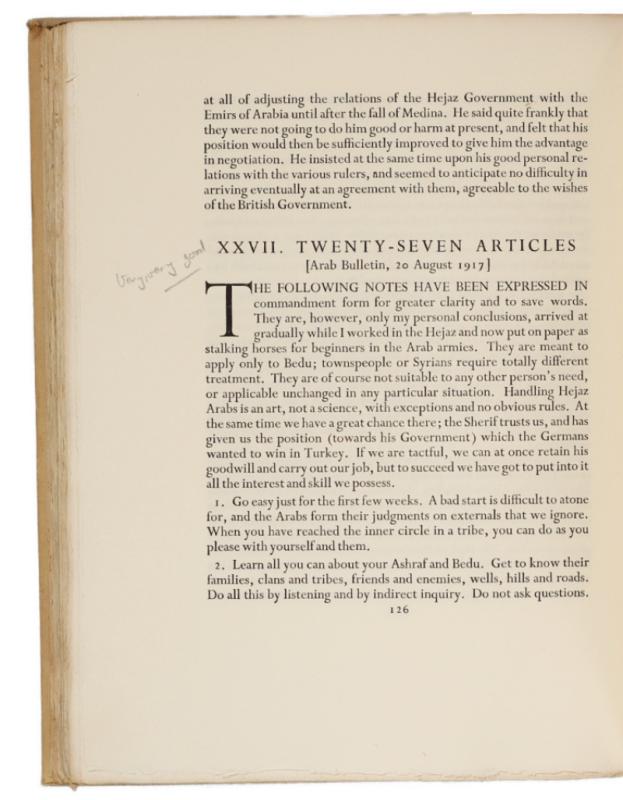
This copy is from the library of David Summers, who was educated at Eton College and Christ Church, Oxford. Summers was commissioned into the Life Guards in 1937, and in the early years of World War II he attended the Cavalry School at Karkur in Central Palestine. Summers records on the upper pastedown, in an apparently later note in ink, that this copy ‘was side-lined [i.e. marked in the margins] by me during the Second World War when I was attending the Cavalry School at Karkur in Palestine. I was writing a treatise on the use of the 1st Cavalry Division and their possible role in the event of the Germans invading Syria, the Lebanon and Palestine through Turkey. My ideas were that they should operate on the eastern flank of any advance from the hills as Lawrence did and that supplies should be stock piled in the hills so that small units could operate behind the German forces as they advanced towards their objective, Cairo’. ¶¶
The marginal markings by Summers occur on some 30 pages, and he has annotated a further four. Some of these markings and annotations translate Arabic words in the text (e.g. on p. 81 ‘harrahs’ is annotated ‘lava’), but many consider the success of Lawrence’s campaign some 25 years earlier and the lessons which might be drawn from them in World War II. For example, on p. 22 the sentence ‘The average range possible is from 200 to 300 yards, and at point-blank ranges the Arabs shoot quite well’ has been marked and in the following sentence the comment that light machine guns should be ‘capable of being carried by hand uphill’ has been underlined. The passages on practicalities of working with Arab soldiers have also been read with interest, and the sentence ‘Inter-communication between units of the Arab forces is often hindered by there being no person in a force who can actually read and write’ has been marked (p. 60). Similarly, the problems British soldiers might face are also identified, such as Lawrence’s comment that a ‘cotton shirt is a handy garment, but not adaptable to such sudden changes in temperature’ (p. 92). Summers appears to have found Lawrence’s famous ‘Twenty-Seven Articles’ – intended as a vade mecum for ‘beginners in the Arab armies’ – particularly relevant and has glossed it ‘Very very good’ (p. 126). ¶¶
Following service in Syria, Iran, and Iraq, Summers subsequently fought in the Italian campaign and was mentioned in dispatches for his actions in Sicily in 1944. Summers left the army with the rank of major, and he was later appointed a Justice of the Peace for Gloucestershire, serving as High Sheriff of Gloucestershire in 1964. ¶¶
F.A. Clements, T.E. Lawrence: A Reader’s Guide, pp. 45-48; P. O’Brien, T.E. Lawrence (2000), A226; C. Sandford and O. Rutter, Pertelote, 145. ¶¶¶
Other books
If you liked the book you've just seen, you might be interested in other books from the same dealer below.
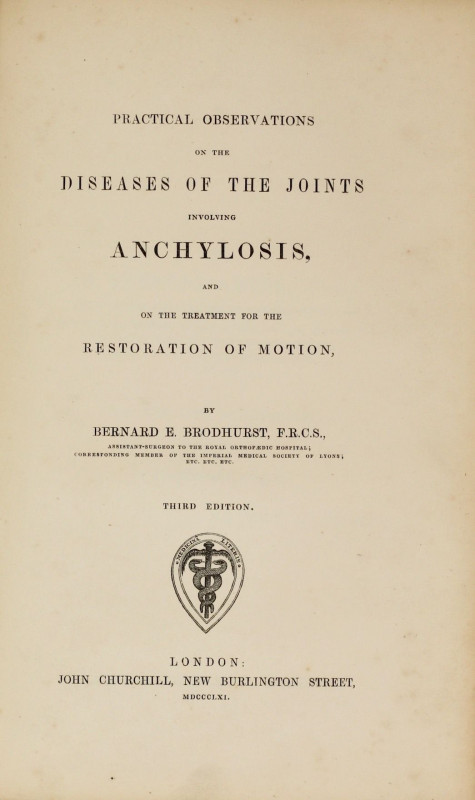
Practical Observations on the Diseases of the Join...
BRODHURST, Bernard Edward.
London: J.E. Adlard for John Churchill,
£125.00
Offered by Type & Forme
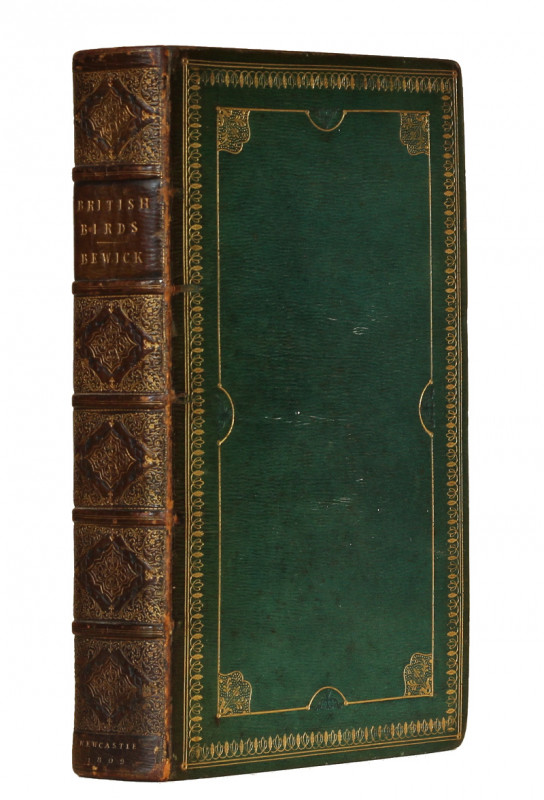
A History of British Birds ...
BEWICK, Thomas
Newcastle: Edward Walker for T. Bewick ‘sold by him, and Longman and Co., London’
£695.00
Offered by Type & Forme
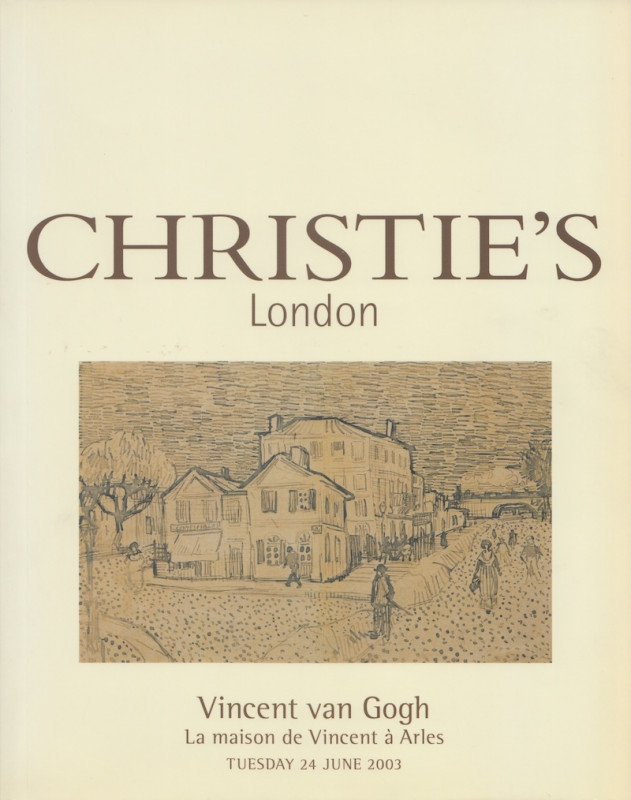
Vincent van Gogh: La maison de Vincent à Arles. Im...
GOGH, Vincent Willem van – CHRISTIE’S
London: Christie’s International Media Division for Christie’s
£19.50
Offered by Type & Forme
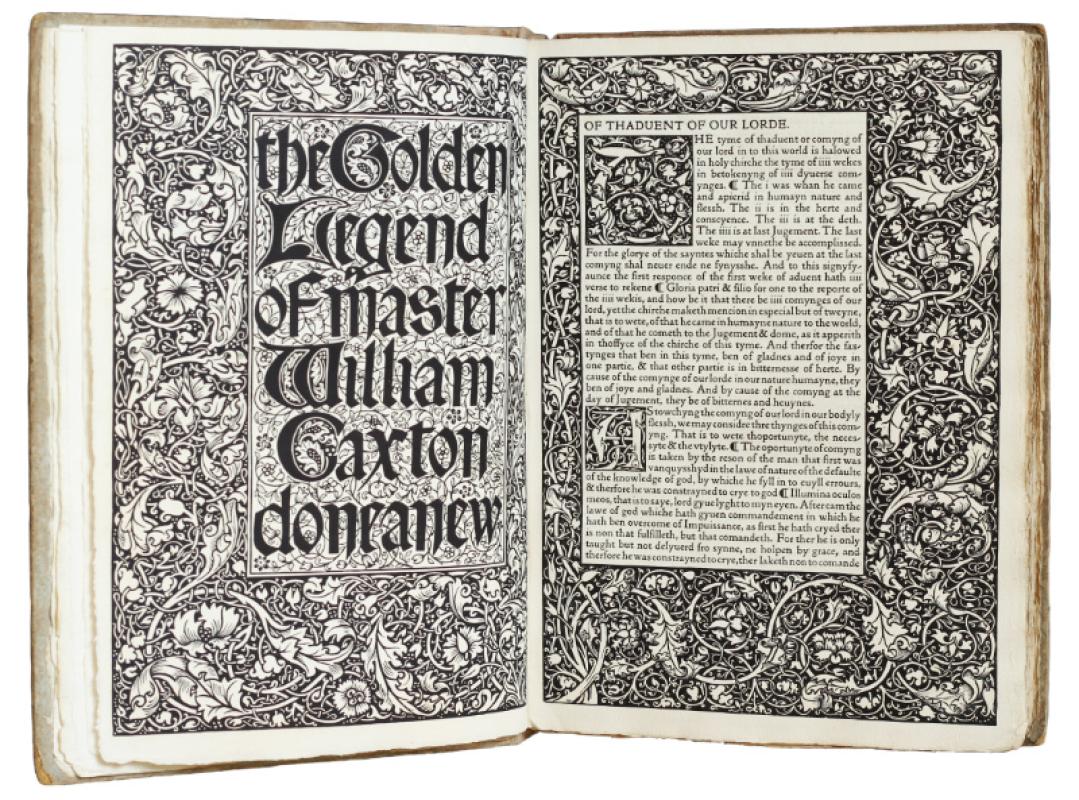
The Golden Legend of Master William Caxton Done An...
VORAGINE, Jacobus de and William CAXTON (translator)
[Hammersmith], ‘printed by me William Morris at the Kelmscott Press [...] Sold by Bernard Quaritch’
£8500.00
Offered by Type & Forme
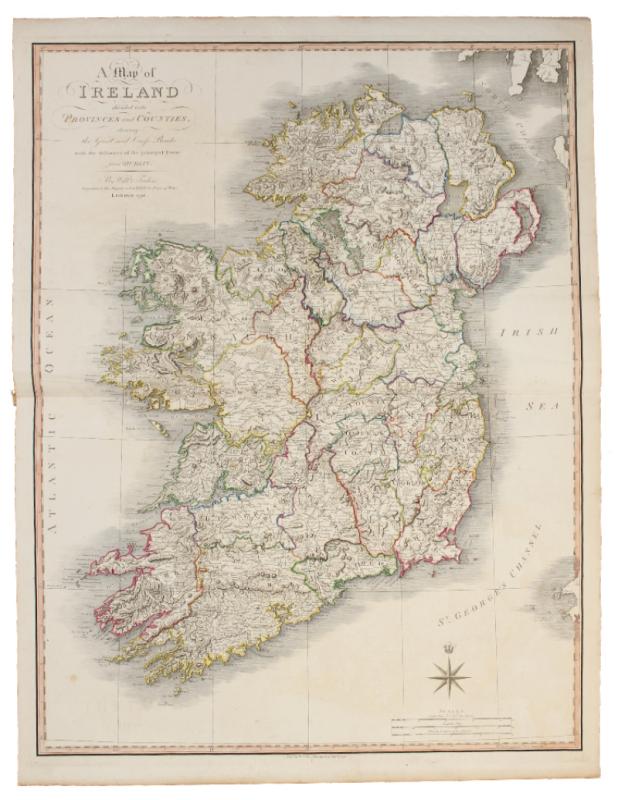
‘A Map of Ireland Divided into Provinces and Count...
FADEN, William
London: William Faden
£295.00
Offered by Type & Forme
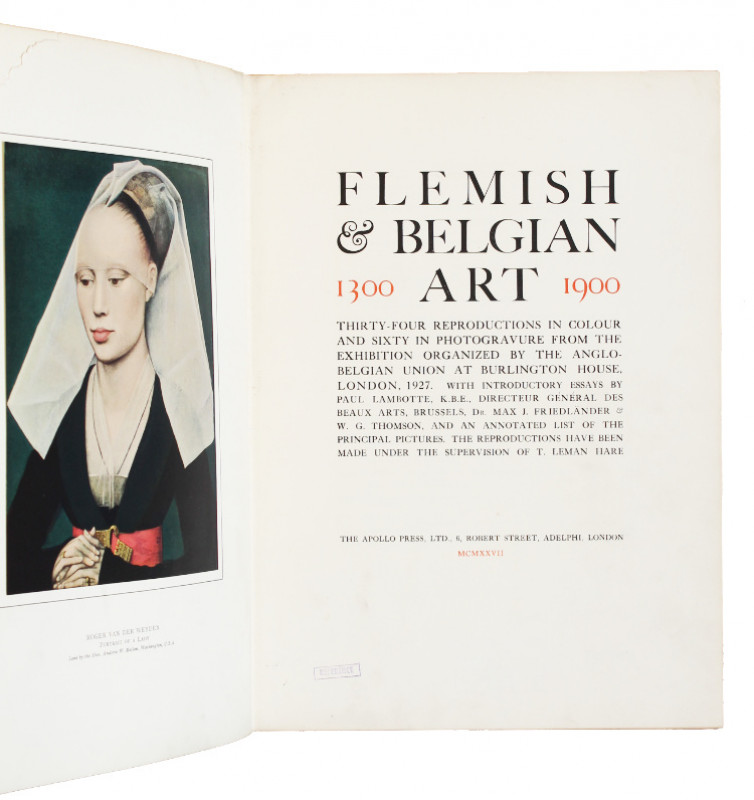
Flemish & Belgian Art, 1300-1900... [first edition...
LAMBOTTE, Paul et al.
London: Geo. Pulman & Sons Ltd. for The Apollo Press, Ltd.
£39.50
Offered by Type & Forme
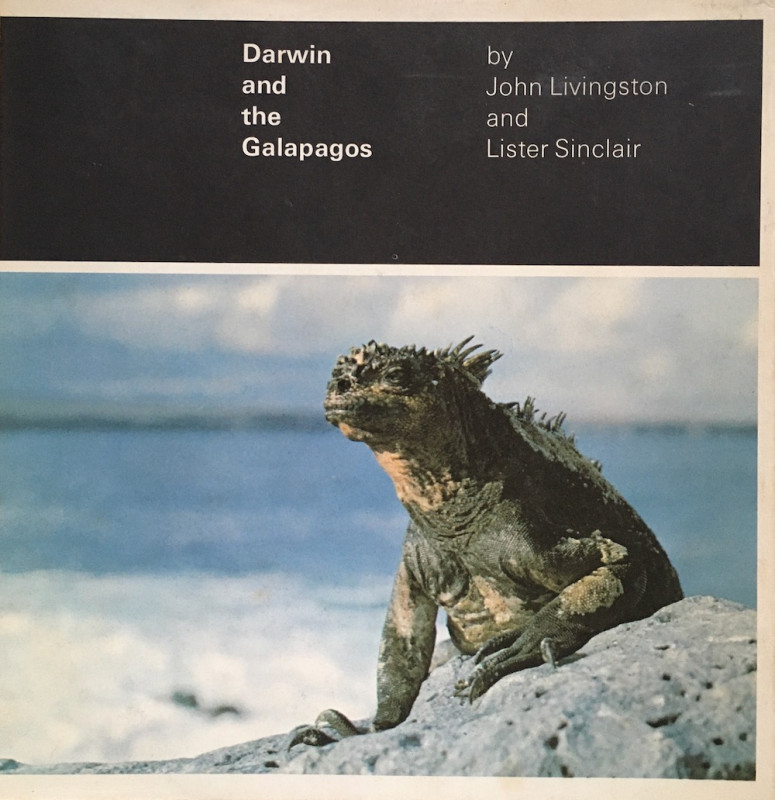
Darwin and the Galapagos
LIVINGSTON, John and Lister SINCLAIR
Toronto: Canadian Broadcasting Corporation
£14.95
Offered by Type & Forme
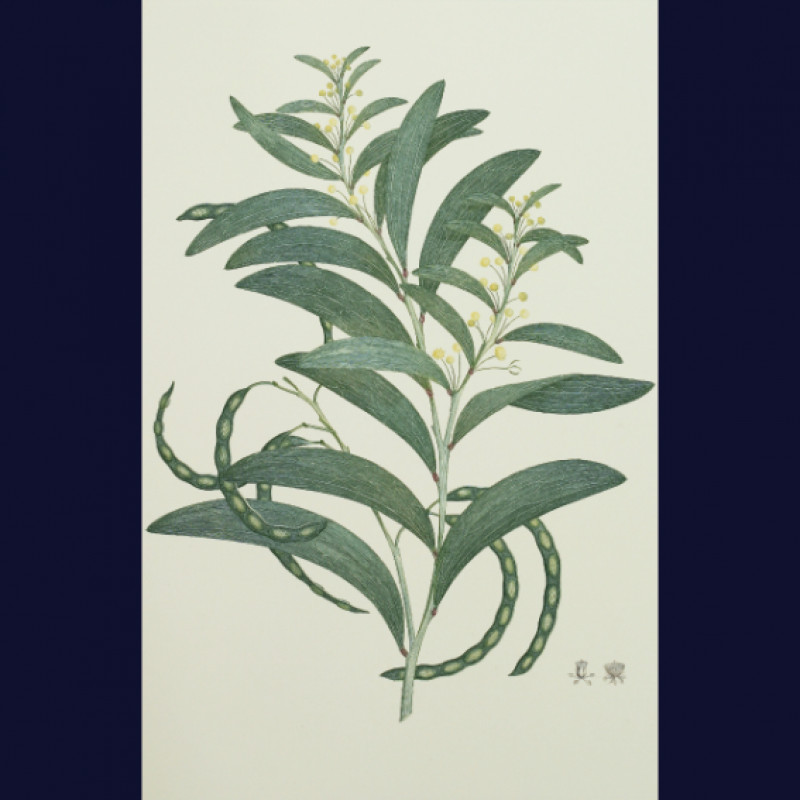
[Joseph Banks’ Florilegium] Plate 89: Acacia Legno...
PARKINSON, Sydney and Frederick Polydore NODDER (artist), Gerald SIBELIUS (engraver).
London: Alecto Historical Editions in association with the British Museum (Natural History)
£510.00
Offered by Type & Forme
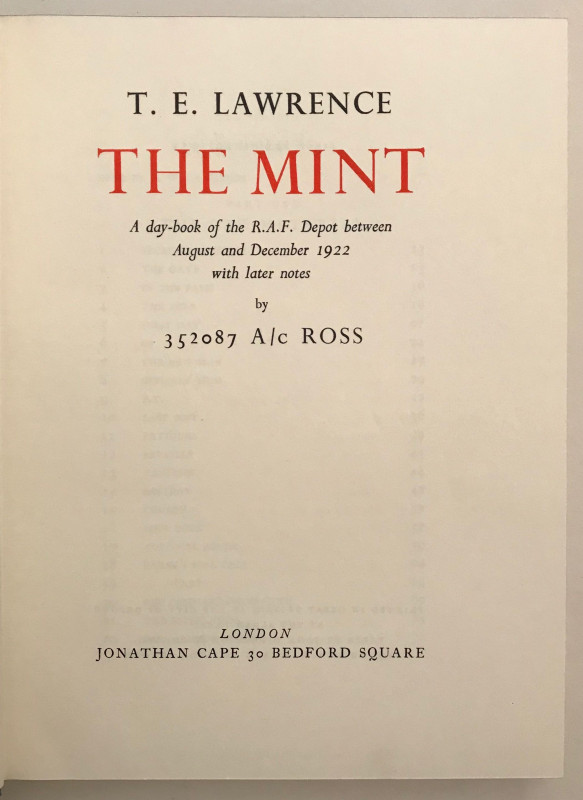
The Mint. A Day-Book of the R.A.F. Depot between A...
LAWRENCE, Thomas Edward.
London: The Alden Press for Jonathan Cape.
£75.00
Offered by Type & Forme
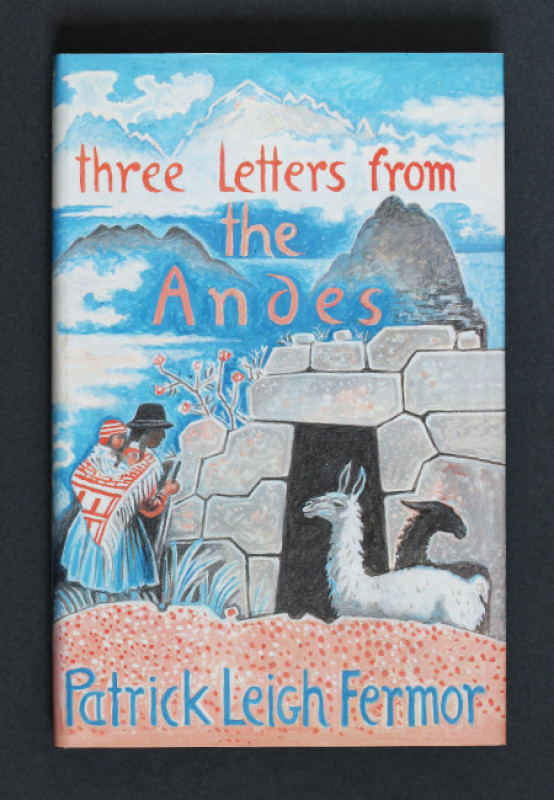
Three Letters from the Andes
FERMOR, Sir Patrick Michael Leigh and John CRAXTON (artist)
London: Butler & Tanner Ltd for John Murray
£39.50
Offered by Type & Forme
Friends of the PBFA
Please email info@pbfa.org for more information